Endorsed by

Our Commitment To Babywearing Safety
Safety Standards
At the Babywearing Hub, safety is at the heart of everything we do. Because Australia currently has no mandatory national standard for baby carriers, we only stock products that meet internationally recognised safety guidelines – such as ASTM (USA) or EU standards – to ensure structural integrity, secure fastenings, and ergonomic support.
Every carrier listed on our site is endorsed by the Australian Babywearing Association. That means each product has passed a rigorous review of its instruction manual, design, and build, with careful scrutiny on how it supports your baby’s hips, spine, head, and overall positioning.
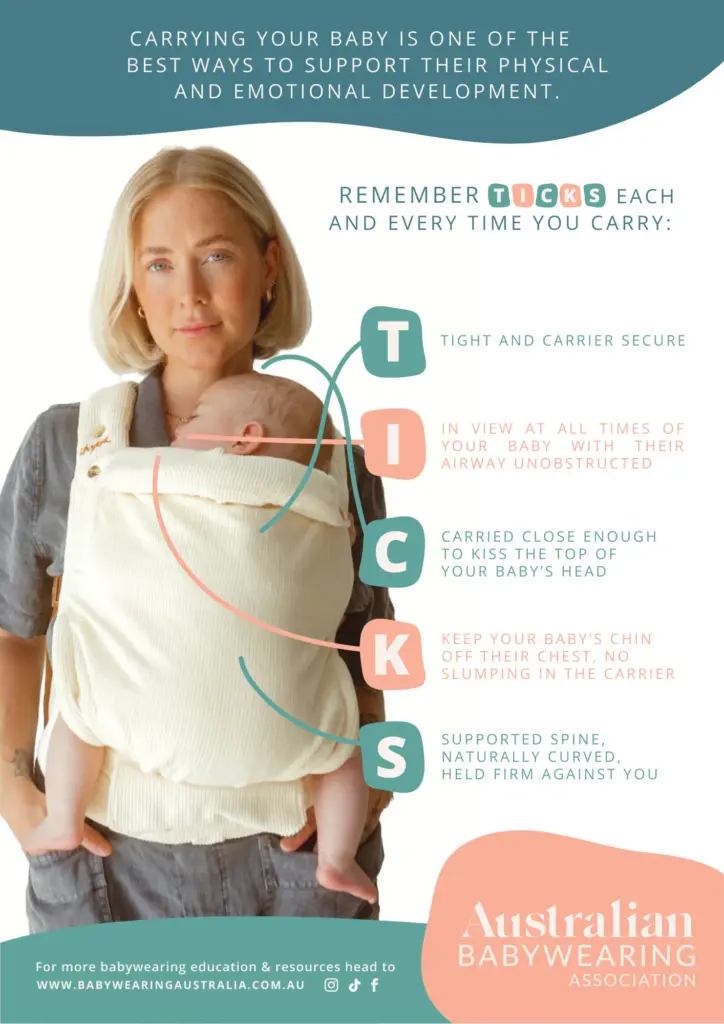
We also encourage all caregivers to follow recommended babywearing safety practices, including the internationally recognised T.I.C.K.S. principles – keeping your baby Tight, In view, Close enough to kiss, their Chin off their chest, and a Supported back.
When carrying your baby in a wrap, sling, or carrier, safety is always the number one priority. We strongly recommend following the internationally-recognised TICKS safety guidelines. These simple but essential checks help make sure your baby’s airway is clear, their body is supported, and you both stay comfortable.
What does TICKS mean?
T = Tight — The carrier should hold your baby firm and secure against your body. Loose fabric or slack can allow your baby to slump, which can compromise their airway and affect both comfort and safety.
I = In view at all times — You should always be able to see your baby’s face by simply glancing down. Their face, especially nose and mouth, must remain unobstructed by fabric.
C = Close enough to kiss — Your baby should be positioned high enough on your chest that if you drop your head down you can kiss the top of their head easily. This ensures your baby is not too low and is in a more secure, upright position.
K = Keep chin off the chest — A baby’s chin should never be forced onto their chest. This position can restrict airflow and pose a risk of suffocation. Make sure there’s at least a two finger-width space under their chin.
S = Supported back — Your baby’s back should be supported in a natural, comfortable position (a gentle “J-curve” for newborns). Their tummy and chest should rest against you, and the carrier should support their spine and hips correctly.
Other Important Safety Tips
In addition to TICKS, here are further guidelines to use whenever you’re carrying your baby:
- Hip-healthy position: For healthy hip development — especially for newborns — ensure that the carrier’s seat or base supports baby’s legs in a spread-squat / “M” position (knees above their bottom). Avoid letting baby’s legs hang straight down. This is more ergonomic and comfortable for you and baby too.
- Watch airways, always: Ensure your baby’s airway is free and clear — nothing (fabric, your clothing, your body) should cover baby’s nose or mouth. If you can’t easily see their face, it’s unsafe.
- Check carrier/ sling condition: Always inspect your carrier for wear and tear — stitching, fabric integrity, buckles or rings — before each use. A durable, well-designed and well-maintained carrier is much safer.
- Use as intended: Follow the manufacturer’s instructions for age / size limits, style (wrap, structured, ring sling, etc.), recommended carrying positions, and proper fitting. Avoid using carriers in ways not recommended (e.g. lying down / cradle-style positions — upright carry is safest for airway and support).
- Be cautious when bending or leaning: If you bend forward, support your baby with at least one hand — many carriers are not designed to keep baby safe when you lean forward without support.
- Avoid unsafe activities: Do not use baby carriers for activities like running, cycling, jumping, or anything where you might fall, lose balance, or otherwise risk sudden jolts — the safety mechanics for a baby carrier don’t substitute for an infant car seat or safe cot.
Why Safety Matters
Babywearing — when done properly — offers wonderful benefits: closeness, bonding, convenience, freedom to move, and comfort for baby. But incorrect use or neglecting safety guidelines can pose serious risks, especially to a baby’s airway. That’s why TICKS was developed: a simple, evidence-based framework that works across any carrier type.
By following the TICKS guidelines — along with the extra tips above — you can reduce the risk of positional asphyxia, ensure healthy hip and spine development, and enjoy babywearing with confidence and peace of mind.